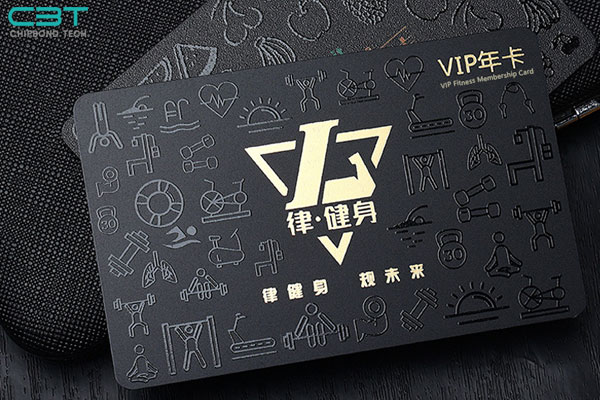
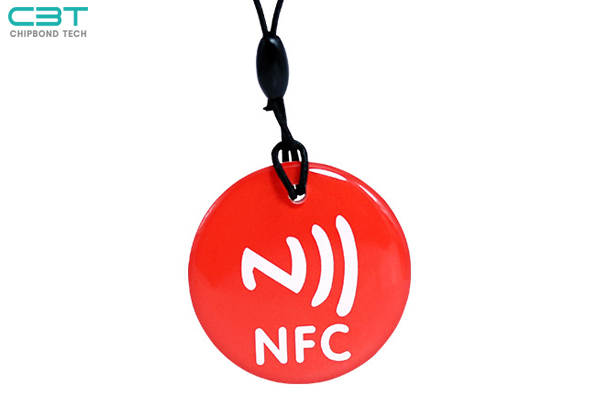
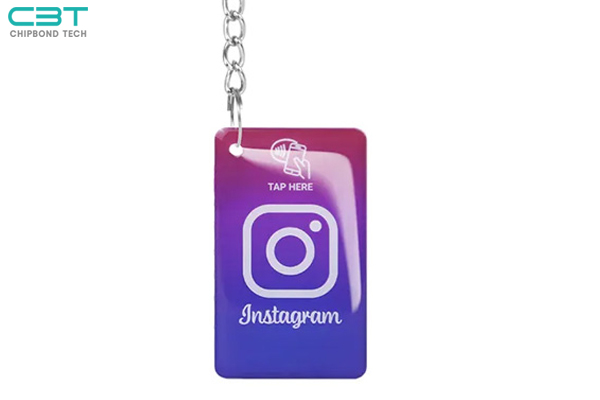
An NTAG213 card is the entry-level building block of many tap-to-anything programmes: business cards, review cards, event badges, product authentication labels, and simple access credentials. Its 144 bytes of user memory look small on a datasheet, and they are — which is exactly why the specification has to be planned before artwork is approved. This guide covers the decisions a buyer actually makes: chip tier, payload budget, encoding model, card construction, print and finish, read behaviour, failure modes, and order terms. For the chip's general features and applications, see our NTAG213 card overview.
NTAG213 is an NXP chip family member compliant with NFC Forum Type 2 and ISO/IEC 14443 Type A. It operates at 13.56 MHz with a 106 kbit/s air interface, carries a factory-programmed 7-byte UID, and offers 144 bytes of user read/write memory inside a 180-byte EEPROM organised in 45 pages of four bytes.
That memory map matters in production, not only in design. Pages 0–2 hold the UID, internal data and static lock bytes; page 3 holds the capability container that declares how much NDEF space is available; pages 4–39 are user memory; pages 40–44 hold dynamic lock bytes, configuration, the 32-bit password and the password acknowledge value.
Where it fits: one payload per tap, read by a phone. Where it does not: multi-record business cards, stored images, offline databases, or anything that needs cryptography on the chip.
The three chips share the same air interface, the same 7-byte UID, the same command set and the same phone compatibility. The difference is memory, and that is the whole decision.
| Chip | EEPROM | User memory | NDEF capacity after formatting | Suitable payload |
|---|---|---|---|---|
| NTAG213 | 180 bytes | 144 bytes | About 137 bytes | One short URL, an ID, a single action |
| NTAG215 | 540 bytes | 504 bytes | About 496 bytes | URL plus vCard, or several NDEF records |
| NTAG216 | 924 bytes | 888 bytes | About 872 bytes | Long text, multi-record sets, larger media |
A practical rule from production: choose by the payload you will need in year three, not the one you need at launch. Moving from 213 to 215 costs a little per card; moving a printed batch is a full reprint. If the plan includes a contact card with name, title, phone, email and links, NTAG215 is the honest starting point.
The number buyers need is not 144 but roughly 130 characters of URL, because NDEF formatting consumes header bytes and the common prefixes are compressed into a single code.
Two engineering notes: reserve bytes for the password feature if you plan to use it, and do not design to the last byte, because a future redirect change may need a longer URL than the original.
Any NFC-enabled phone can read an NDEF-formatted NTAG213 card: Android devices with NFC, and iPhones from the model generations that added background tag reading. Desktop USB readers built for ISO/IEC 14443A work as well, which is what many encoding stations use.
Test on the phones your users actually carry, not on the one on your desk. This is a frequent pilot failure.
These two are often compared for the wrong reason. NTAG213 is a data carrier with a light password feature; MIFARE Classic is a memory card with sector keys.
| NTAG213 | MIFARE Classic 1K | |
|---|---|---|
| Memory | 144 bytes user | 1 KB, 16 sectors |
| Typical use | Tap-to-URL, ID, simple action | Legacy access control, stored value |
| Security model | 32-bit password, lock bits | Crypto1 authentication, publicly broken |
| Phone-readable | Yes, NDEF | Yes, with app support |
If the requirement is "a phone should open a link", NTAG213 is the right part. If the requirement is "a door should open only for this card", neither chip is a full answer — the reader and controller decide, and a cryptographic chip such as DESFire sits above both. Our MIFARE Ultralight article covers the neighbouring tier.
Three features are frequently specified and frequently misunderstood.
State clearly which of the three you need. "Password protected" on a purchase order can mean any of them.
| Format | Typical build | Suitable for |
|---|---|---|
| Standard card | PVC, 0.76 mm, CR80 | Business cards, membership, events |
| Paper or sticker | Paper face with inlay, adhesive back | Posters, packaging, review stickers |
| Epoxy tag | Chip and antenna under resin | Keyrings, harsh handling |
| Anti-metal | Ferrite layer between inlay and metal | Equipment, metal furniture |
The constraint that catches projects late is metal. An NTAG213 inlay placed directly on a metal surface detunes; the read range collapses. An anti-metal build adds a ferrite sheet, which costs more and adds thickness. Decide that at the sampling stage, because it changes the card structure, not only the artwork.
For stock formats and card builds, see RFID cards and blank cards.
A tap card is a printed product before it is an electronic one, and the finish affects read behaviour.
Two production details matter more than the design: keep the antenna window free of foil or metallic ink, and keep the print registration stable so the "tap here" mark sits over the coil rather than beside it. Printed options are listed under printed cards.
Four models cover many orders:
Encoding and printing must agree: the number printed on the card should be the number the reader returns. Ask for a read-back report for the production batch, not just for the sample. Where a password is used, agree the PWD and PACK values in writing and keep them out of email threads.
For a CR80 NTAG213 card, a realistic read distance with a phone is a few centimetres, commonly quoted as 2–10 cm depending on the reader and antenna. Smaller formats — a 30 mm sticker, a keyring tag — trade range for size.
Three factors move that number: the antenna area inside the card, the phone's coil position, and nearby metal. Thick phone cases, magnetic mounts, and a card kept in a wallet with other cards all reduce the working distance. The chip datasheet's operating temperature is −25 °C to 85 °C; a finished PVC card is limited by the PVC body, which softens well below that upper figure.
Each of these is a specification error rather than a chip defect, which is why the build sheet matters more than the datasheet.
Cost is driven by four things: card construction, print method, encoding model, and quantity per design. Setup — plates, proofs, encoding profiles — is fixed per artwork, so unit price falls between a 500-piece and a 5,000-piece run.
A sequence that avoids reprints: approve the card build and chip on a physical sample, verify it on the target phones, confirm the NDEF payload length, then release bulk. CBT holds standard stock for 24-hour sampling, runs its own PVC sheet line, and publishes capacity and yield figures under capacity and quality.
144 bytes of user memory, of which about 137 bytes remain usable for an NDEF message — enough for a short URL or an ID, not for a full vCard.
Yes. Both read NDEF content natively; writing from a phone usually requires an app with the right permission.
Not on the same card. The chip is fixed at production, so choose 215 or 216 at the sampling stage if the payload may grow.
It suits low-risk, phone-tap scenarios. For doors, the reader and controller carry much of the security; high-value sites should use a cryptographic chip.
Write access, or read access if configured that way, against casual rewriting. It does not encrypt the payload.
Yes, using lock bits, and the change is irreversible. Lock only after the final payload has been verified on the target phones.
Not directly. A standard inlay on metal detunes; an anti-metal build with a ferrite layer is required.
A few centimetres with a phone, commonly 2–10 cm, depending on antenna size, phone model and nearby metal.
Yes. Blank, uniform URL, serialised URL, or multi-record NDEF are all available, with a matching data file and a batch read-back report.
Printed runs typically start in the hundreds to low thousands per design depending on print and encoding; blank stock can ship in smaller quantities.
Send the intended payload, the target phone models, the card format and the quantity to info@chipbond.com, and our engineers will reply within one business day with a build sheet and a sample proposal — engineering answers rather than a template quotation.
CBT has manufactured RFID products since 1996, consumes 800 million chips a year, produces 1.5 million pieces a day at a 99.8% yield, and holds standard stock for 24-hour sampling. Two production bases, in China and Thailand, give you capacity redundancy in peak season, a legitimate alternative origin where Chinese-origin goods face extra duty, shorter logistics to your warehouse or port, and one IQC/QA standard across both plants.
Tell us the destination country and we will quote from whichever base gives you the better landed cost.